
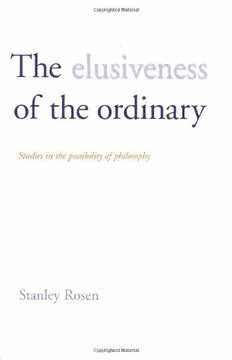
Download The Elusiveness of the Ordinary: Studies in the Possibility of Philosophy PDF Free - Full Version
Download The Elusiveness of the Ordinary: Studies in the Possibility of Philosophy by Professor Stanley Rosen in PDF format completely FREE. No registration required, no payment needed. Get instant access to this valuable resource on PDFdrive.to!
About The Elusiveness of the Ordinary: Studies in the Possibility of Philosophy
The concept of the ordinary, along with such cognates as everyday life, ordinary language, and ordinary experience, has come into special prominence in late modern philosophy. Thinkers have employed two opposing yet related responses to the notion of the ordinary: scientific and phenomenological approaches on the one hand, and on the other, more informal or even anti-scientific procedures. Eminent philosopher Stanley Rosen here presents the first comprehensive study of the main approaches to theoretical mastery of ordinary experience. He evaluates the responses of a wide range of modern and contemporary thinkers and grapples with the peculiar problem of the ordinary – how to define it in its own terms without transforming it into a technical (and so, extraordinary) artifact. Rosen’s approach is both historical and philosophical. He offers Montesquieu and Husserl as examples of the scientific approach to ordinary experience; contrasts Kant and Heidegger with Aristotle to illustrate the transcendental approach and its main alternatives; discusses attempts by Wittgenstein and Strauss to return to the pre-theoretical domain; and analyzes the differences among such thinkers as Moore, Austin, Grice, and Russell with respect to the analytical response to ordinary language. Rosen concludes with a theoretical exploration of the central problem of how to capture the elusive ordinary intact.
Detailed Information
| Author: | Professor Stanley Rosen |
|---|---|
| Publication Year: | 2002 |
| ISBN: | 9780300129526 |
| Pages: | 336 |
| Language: | English |
| File Size: | 1.05 |
| Format: | |
| Price: | FREE |
Safe & Secure Download - No registration required
Why Choose PDFdrive for Your Free The Elusiveness of the Ordinary: Studies in the Possibility of Philosophy Download?
- 100% Free: No hidden fees or subscriptions required for one book every day.
- No Registration: Immediate access is available without creating accounts for one book every day.
- Safe and Secure: Clean downloads without malware or viruses
- Multiple Formats: PDF, MOBI, Mpub,... optimized for all devices
- Educational Resource: Supporting knowledge sharing and learning
Frequently Asked Questions
Is it really free to download The Elusiveness of the Ordinary: Studies in the Possibility of Philosophy PDF?
Yes, on https://PDFdrive.to you can download The Elusiveness of the Ordinary: Studies in the Possibility of Philosophy by Professor Stanley Rosen completely free. We don't require any payment, subscription, or registration to access this PDF file. For 3 books every day.
How can I read The Elusiveness of the Ordinary: Studies in the Possibility of Philosophy on my mobile device?
After downloading The Elusiveness of the Ordinary: Studies in the Possibility of Philosophy PDF, you can open it with any PDF reader app on your phone or tablet. We recommend using Adobe Acrobat Reader, Apple Books, or Google Play Books for the best reading experience.
Is this the full version of The Elusiveness of the Ordinary: Studies in the Possibility of Philosophy?
Yes, this is the complete PDF version of The Elusiveness of the Ordinary: Studies in the Possibility of Philosophy by Professor Stanley Rosen. You will be able to read the entire content as in the printed version without missing any pages.
Is it legal to download The Elusiveness of the Ordinary: Studies in the Possibility of Philosophy PDF for free?
https://PDFdrive.to provides links to free educational resources available online. We do not store any files on our servers. Please be aware of copyright laws in your country before downloading.
The materials shared are intended for research, educational, and personal use in accordance with fair use principles.

