
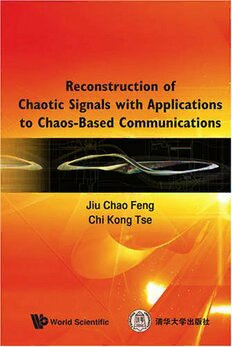
Download Reconstruction of chaotic signals with applications to chaos-based communications PDF Free - Full Version
Download Reconstruction of chaotic signals with applications to chaos-based communications by Jiu Chao Feng, Chi Kong Tse in PDF format completely FREE. No registration required, no payment needed. Get instant access to this valuable resource on PDFdrive.to!
About Reconstruction of chaotic signals with applications to chaos-based communications
This book provides a systematic review of the fundamental theory of signal reconstruction and the practical techniques used in reconstructing chaotic signals. Specific applications of signal reconstruction methods in chaos-based communications are expounded in full detail, along with examples illustrating the various problems associated with such applications. The book serves as an advanced textbook for undergraduate and graduate courses in electronic and information engineering, automatic control, physics and applied mathematics. It is also highly suited for general nonlinear scientists who wish to understand the basics of chaos-based signal and information processing. Written with numerous illustrative applications to capture the interest of casual readers, the book also contains adequate theoretical rigor to provide the necessary foundational as well as advanced material for serious researchers who are working or aspire to work in this area. Contents: Chaos and Communications; Reconstruction of Signals; Fundamentals of Neural Networks; Signal Reconstruction in Noisefree and Distortionless Channels; Signal Reconstruction from a Filtering Viewpoint: Theory; Signal Reconstruction from a Filtering Viewpoint: Application; Signal Reconstruction in Noisy Channels; Signal Reconstruction in Noisy Distorted Channels; Chaotic Network Synchronization and Its Applications in Communications.
Detailed Information
| Author: | Jiu Chao Feng, Chi Kong Tse |
|---|---|
| Publication Year: | 2008 |
| ISBN: | 9789812771131 |
| Pages: | 235 |
| Language: | English |
| File Size: | 8.753 |
| Format: | |
| Price: | FREE |
Safe & Secure Download - No registration required
Why Choose PDFdrive for Your Free Reconstruction of chaotic signals with applications to chaos-based communications Download?
- 100% Free: No hidden fees or subscriptions required for one book every day.
- No Registration: Immediate access is available without creating accounts for one book every day.
- Safe and Secure: Clean downloads without malware or viruses
- Multiple Formats: PDF, MOBI, Mpub,... optimized for all devices
- Educational Resource: Supporting knowledge sharing and learning
Frequently Asked Questions
Is it really free to download Reconstruction of chaotic signals with applications to chaos-based communications PDF?
Yes, on https://PDFdrive.to you can download Reconstruction of chaotic signals with applications to chaos-based communications by Jiu Chao Feng, Chi Kong Tse completely free. We don't require any payment, subscription, or registration to access this PDF file. For 3 books every day.
How can I read Reconstruction of chaotic signals with applications to chaos-based communications on my mobile device?
After downloading Reconstruction of chaotic signals with applications to chaos-based communications PDF, you can open it with any PDF reader app on your phone or tablet. We recommend using Adobe Acrobat Reader, Apple Books, or Google Play Books for the best reading experience.
Is this the full version of Reconstruction of chaotic signals with applications to chaos-based communications?
Yes, this is the complete PDF version of Reconstruction of chaotic signals with applications to chaos-based communications by Jiu Chao Feng, Chi Kong Tse. You will be able to read the entire content as in the printed version without missing any pages.
Is it legal to download Reconstruction of chaotic signals with applications to chaos-based communications PDF for free?
https://PDFdrive.to provides links to free educational resources available online. We do not store any files on our servers. Please be aware of copyright laws in your country before downloading.
The materials shared are intended for research, educational, and personal use in accordance with fair use principles.

