Table Of ContentM
a
n
e
l
i
u
s
F
a
b
r
i
c
F
o
r
m
w
o
r
k
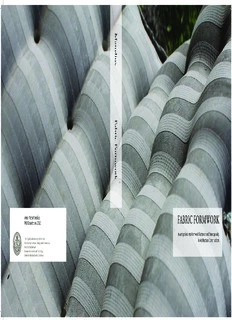
Anne-Mette Manelius FABRIC FORMWORK
PhD Dissertation, 2012
Investigations into Formwork Tectonics and Stereogeneity
The Royal Danish Academy of Fine Arts
in Architectural Constructions
Schools of Architecture, Design, and Conservation
School of Architecture
Institute of Architectural Technology
Center for Industrialized Architecture
FABRIC FORMWORK FOR CONCRETE
INVESTIGATIONS INTO FORMWORK TECTONICS AND STEREOGENEITY
IN ARCHITECTURAL CONSTRUCTIONS
PhD dissertation by Anne-Mette Manelius
“Fabric Formwork for Concrete - Investigations into Formwork Tectonics and
Stereogeneity in Architectural Constructions”
PhD Dissertation © 2012 Anne-Mette Manelius
Published at the Royal Danish Academy of Fine Arts
Schools of Architecture, Design and Conservation
School of Architecture
Institute of Architectural Technology
CINARK - Center for Industrialized Architecture
The dissertation is based on an Industrial PhD project financed through
the Industrial PhD Programme of the Danish Agency for Science, Technol-
ogy and Innovation and the industrial PhD partners E. Pihl & Son A.S. and
schmidt hammer lassen architects
Supervisors
Anne Beim, CINARK
Rolf Carlsen, E. Pihl & Son
Mads Kaltoft, schmidt hammer lassen architects
Layout: Lykke Sanddal, Rikke Paluszewski Majgaard, Marianne Simonsen,
and Anne-Mette Manelius
Printed in June 2012 at the Print Center of the Royal Danish Academy of
Fine Arts, Schools of Architecture, Design and Conservation
ISBN: 978-87-7830-297-7
The dissertation consists of two volumes: this dissertation and an appendix
of ‘Experimental Data’
Language: English
Key words: Architecture, Building Materials, Concrete, Textile, Research
Through Design, Fabric Formwork, Tectonics.
Emneord: Arkitektur, byggematerialer, beton, tekstil, arkitektonisk
udviklingsarbejde, tekstilforskalling, tektonik, stereogenitet.
The Royal Danish Academy of Fine Arts
Schools of Architecture, Design, and Conservation
School of Architecture
Institute of Architectural Technology
Center for Industrialized Architecture
ACKNOWLEDGEMENTS
The thesis work presented in this dissertation is framed by the Danish Finn Hakonsen of NTNU, Norway, for collaboration in Erasmus 2010 and
Industrial PhD programme. The programme only has few projects in discussions about formwork tectonics.
the construction sector and the present dissertation is among the first • The Norwegian ByggUtenGrenser for dialogue and inspiration.
Industrial PhDs at the Royal Danish Academy of Fine Art, School of • Morten Lund for the hospitality at Chalmers University of Technology,
Architecture (RDAFASA). Sweden.
Therefore it is appropriate to acknowledge: • Frederik Petersen and Kathrine Næss for collaboration during the
• Head of CINARK Anne Beim for the continuous support prior to and workshop Concrete Flesh.
during the thesis work.
• Rolf Carlsen, the Head of Business Development at E.Pihl &Son, for his Members of Innovation Lab Denmark (Byggeriets Innovation) Natalie
open mind and courage, and for taking the project on, and Ulrik Nilaus Mossin, Mikkel Andreas Thomassen, and Kjeld Schrøder for the early
Hven and Thomas Nielsen of Pihl for support and feedback during the dialogues and enthusiasm about ‘casting in stockings.’
project.
• Lars Bejer, senior project manager, and Morten Holm, partner of Foreningen San Cataldo for the refuge stipend, and to fellow ‘convent
schmidt hammer lassen architects for introducing the project to the fellows’ in April 2011 for discussions and encouragement and interest, even
architectural office, and Mads Kaltoft for supervising. though it was “a shame that the topic is concrete.”
The International Society of Fabric Forming (ISOFF):
At the Royal Danish Academy of Fine Arts, School of Architecture:
• Sandy Lawton for hospitality during the workshop in Vermont 2009
• Students from RDAFASA and DTUByg who participated in the TEK1
• Remo Pedreschi from the Edinburgh School of Architecture and Land-
workshops
scape Architecture for hospitality during my visit in October 2008
• Signe Ulfeldt for assisting in experiments and for the documentation of
• Diederik Veenendaal, John Orr, Kaloyana Kostova, and Daniel Sang-
formwork tectonics with beautiful photos.
Hoon Lee for knowledge sharing at the fabric formwork seminar at ETH-
RDAFASA, Institute of Architectural Technology: Zürich, June 2010; Daniel also for sparring at RDAFASA.
• Peter Sørensen for sharing his experience and coolness during organiz-
ing and teaching the Tectonic Culture, Erasmus Summer School 2010. Unicon Beton and Bornholms Betonværk for supplying concrete and
• Finn Bach and Johannes Rauff Greisen (CINARK) for musketeer-like col- patience during workshop pours at the RDAFASA and Bornholm.
laboration for the TEK1 workshops 2009-2011
Iosif Alygizakis for etymological expertice for the becoming of stereogenés.
At the Technical University of Denmark (DTU):
• Kurt Kielsgaard and Lotte Bjerregaard for collaboration and hospitality And finally, this project is in debt to the open nature and hospitality of staff
at DTUByg. members of the Center for Architectural Structures and Technology (CAST),
• Jannie Bakkær Sørensen and Ida Højgaard Wonsild for taking on the Ronnie Araya and especially Aynslee Hurdal, and director at CAST Mark
topic of seams in fabric formwork in their diploma-project at DTU-Byg. West who literally brought fabric formwork to Denmark in a sports bag in
Jannie also for assisting in experiments and workshops. September 2007.
• Elisabeth Jacobsen Heimdal of DTU Management for collaboration and
discussions about the art of doing research through workshops.
CONTENT
1/ BEGINNING 10 Summary (English and Danish)
12 Selected terminology
14 Organization of the dissertation
15 Background
2/ THEORY AND CONCEPTS 21 Introduction and research question
29 Methodology
43 Conceptual framework
3/ PRACTICAL INVESTIGATION 59 Concrete and concreting
69 Stereogeneous construction
75 Textiles in construction
79 Fabric formwork for concrete
4/ ANALYTICAL INVESTIGATION 99 Documentation and comparison
105 Presentation of analytical cases
107 Frame
145 Form Tie
173 Textile
5/ PERSPECTIVES 225 Perspectives of findings
Reflection of methodology and findings
Contribution to practice
233 Bibliography and references
APPENDIX/ EXPERIMENTAL DATA 241 1/ CAST Columns at RDAFASA
2/ Tek 1 2009
3/ Ambiguous Chair
4/ Vermont Wall
5/ Concrete Flesh, Chalmers
6/ Tek1 2010
7/ Concretum, Erasmus Summer School
8/ Tek1 2011
9/ Texts
1/ BEGINNING
Summary and Sammendrag (Danish)
Selected terminology
Organization of the dissertation
Background
Description:Key words: Architecture, Building Materials, Concrete, Textile, Research béton / Concrete Love”, L'Architecture d'Aujourd'Hui N 381 (Archi- press