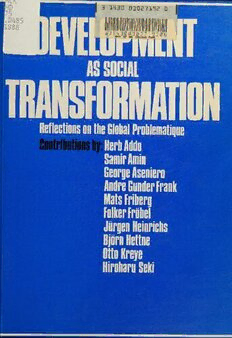
Table Of ContentTRANSHORMATION
AS SOCIAL
Reflections on the Global Problematique
eo Herb Addo
Samir Amin
feorge Aseniero
Andre Gunder Frank
Mats Friberg
Folker Frébel
Jiirgen Heinrichs
Bjorn Hettne
Otto Kreye
Hiroharu Seki
The United Nations University is an organ of the United Nations
established by the General Assembly in 1972 to be an international
community of scholars engaged in research, advanced training, and the
dissemination of knowledge related to the pressing global problems of
human survival, development, and welfare. Its activities focus mainly on
peace and conflict resolution, development in a changing world, and
science and technology in relation to human welfare. The University
operates through a worldwide network of research and post-graduate
training centres, with its planning and co-ordinating headquarters in
Tokyo, Japan.
- Development As Social
Transformation
Reflections on the Global Problematique
contributions by: Herb Addo
Samir Amin
George Aseniero
Andre Gunder
Frank
Mats Friberg
Folker Froébel
Jiirgen Heinrichs
Bjorn Hettne
Otto Kreye
Hiroharu Seki
UNIVERS:TY OF MARi t
MCKELDWN Ligzapy
MAY 1 8 1989
DOCUMENTS/MAPS RooY
(vu) THE UNITED NATIONS UNIVERSITY
© The United Nations University, 1985
The views expressed in this publication are those of the authors and do not necessarily
reflect the views of the United Nations University.
The United Nations University
Toho Seimei Building, 2-15-1 Shibuya, Shibuya-ku, Tokyo 150, Japan
Tel.: (03) 499-2811 Telex: J25442 Cable: UNATUNIV TOKYO
Second printing, 1988
Printed in Singapore
HSDB-12/UNUP-483
ISBN 92-808-0483-9
United Nations Sales No. E.88.I.A.11
02000 P
Contents
Foreword
Introduction |
Chapter 1 Beyond Eurocentricity: Transformation and
Transformational Responsibility
Herb Addo Js
Chapter 2 A Reflection on Developmentalism: From
Development to Transformation
George Aseniero 48
Chapter 3 Dead End: Western Economic Responses to the
Global Economic Crisis
Folker Frébel, Jurgen Heinrichs, Otto Kreye 86
Chapter 4 The Global Crisis and Developing Countries
Folker Frébel, Jiirgen Heinrichs, Otto Kreye 111
Chapter 5 From Atlantic Alliance to Pan-European Entente:
Political Economic Alternatives
Andre Gunder Frank 125
Chapter 6 Militarization and Development
Hiroharu Seki 183
Chapter 7 The Greening of the World - Towards a Non-
Deterministic Model of Global Processes
Mats Friberg and Bjérn Hettne 204
Chapter 8 A Propos the ‘Green’ Movements
Samir Amin 271
About the Contributors
Herb Addo, Institute of International Relations, University of the West
Indies, St. Augustine, Trinidad, West Indies.
Samir Amin, United Nations Institute for Training and Research
(UNITAR), Project ‘Strategies for the Future of Africa’, Dakar,
Senegal.
George Aseniero, United Nations University, Tokyo, Japan.
Andre Gunder Frank, Institute for the Socio-Economic Studies of
Developing Regions, University of Amsterdam, Netherlands.
Mats Friberg and Bjorn Hettne, Department of Peace and Conflict
Research, University of Gothenburg, Sweden.
Folker Frobel, Jiirgen Heinrichs and Otto Kreye, Starnberg Institute
for the Study of Global Structures, Developments and Crises, Federal
Republic of Germany.
Hiroharu Seki, Institute for Asia Pacific Peace Policy, Tokyo, Japan.
Foreword
I am pleased to write the foreword to this research product of the
United Nations University’s Goals, Processes, and Indicators of
Development Project (UNU-GPID).
This book is one of comprehensive findings of the group of research-
ers within the GPID which concerned itself principally with the macro
aspects of the development content of the global problematique.
Even though readers will know this from the description of the
authors, it is important that I point out the prominent fact that the
authors come from, and have lived in, different parts of the world,
from where they have gathered their perspectives on the developmental
implications of the overall conception(s) of the global problematique.
While the richness of the contents of the book is amply demonstrated
in the individual chapters, I would like to draw readers’ attention to the
integrative coherence of the work. It is noteworthy that, despite the
diverse nature of the chapter topics, there is the underlying unity of
purpose and shared concerns in the treatments of these topics.
As a product of the UNU-GPID, we must know that all the chapters
in this book were presented and discussed at several GPID Meetings, at
different stages of their construction.
However, in their final forms, the arguments and views expressed in
each of the chapters owe a lot to the two GPID Meetings held in
Starnberg, July-August 1982, and in Colombo, August 1982. It was at
these meetings that the coherence between the individual chapters in
this book were discussed and agreed upon from the integrative point of
view.
This book then is one of the authentic results of the GPID, which was
initiated and brought together by Johan Galtung, the Co-ordinator of
the project from 1979 to 1981. As the Co-ordinator of the project
during its integrative phase, 1981-1983, I am not only proud to pro-
nounce this book as such, but at the same time also as a set of serious
reflections on the developmental implications of the global
problematique.
Carlos Mallmann
Digitized by the Internet Archive
In 2022 with funding from
Kahle/Austin Foundation
https ://archive.org/details/develoomentassocO000unse
Introduction
The global problematique
Two common motives unite the contributors to this volume: on the one
hand, a deep concern to understand the world as a unity, as an inter-
related totality, and on the other, a commitment to transform it. Trans-
formation here is understood as the unfolding, or preservation, of
structures and processes which can yield and secure the bases of life
for all the world’s inhabitants under just, equitable and therefore
humane conditions: only such a transformation merits the designation
‘development’.
Underlying the separate contributions, therefore, is a collective,
reflective and critical endeavour to understand the origins of, and con-
temporary requirements for, realizing the idea of development and the
relationship between this idea and the global problematique. What then
is the global problematique?
Considered empirically, the global problematique can be specified as
a complex set of interacting elements which in toto characterize the
current state of the world. And by virtue of the fact that the world-
system does not provide those who compose and populate it with the
preconditions for an existence consonant with the minimum demands
of humanity, both the elements in the global problematique and the
global problematique itself as a whole are loaded with negative and
even life-threatening properties.
Each of the chapters in this book deals with different aspects and
outcomes of this all-embracing problematique: the nature of the cur-
rent crisis in the world economy; deteriorating North-South and East-
West relations; new advances in militarization under the threat of war;
distinctive European political options in the face of intensifying super-
power rivalry; the ‘development of under-development’ versus ‘genu-
ine development’ in the Third World; the relations between emerging
and existing social movements; evaluation of the developmental
strengths of anti-systemic forces; and philosophical and _ historical
critiques of the foundations of standard development thinking.
In exploring the systematic interrelationships between these aspects
and outcomes, each seeks to demonstrate why standard or dominant
development thinking and practice are not only ineffective, but actually
2 DEVELOPMENT AS SOCIAL TRANSFORMATION
generate further underdevelopment. In their individual ways, the
authors proceed to indicate some of the conditions, alternatives, and
derivative political choices open to the future, which have to be con-
fronted if the realization of the development objective, as a final pro-
ject, is ever to be achieved.
Despite evident differences in approach, the contributions are organ-
ically cohesive in the sense that they share both the assumption and
conclusion that any serious reflection on development must culminate
in the idea that development - as defined above - entails a global social
transformation. Development is not global in scope because it is simply
‘the common concern of all’, or because ‘it affects us all’ but in the
primordial sense that it is only in terms of the historical evolution and
continuing dynamics of the world-system as a whole that the develop-
ment-underdevelopment relation can be grasped; and that, conse-
quently, it is only through a full confrontation with the logic and
dynamics of the world-system that authentic and realistic alternative
development policies and perspectives can be conceived. Finally, the
problem of development is global in the sense that it refers not only to
the plight of the peoples of the ‘underdeveloped’ countries but equally
to the urgent concerns of those of the ‘developed’ countries as well,
both in the West and in the East, as they strive to grapple with their own
socio-economic and political problems.
Whatever the specific topic chosen, each discussion leads to the same
general conclusion that the prospects of mitigating, much less solving,
the pressing problems of humanity within the present world-system are
practically nil - a situation likely to deteriorate still further as the
global crisis continues to intensify and deepen. The bankruptcy of
dominant development models, the deterioration of living conditions
virtually everywhere, the sharpening of conflicts within and between
nations, and the destruction of the natural foundations of existence
should overwhelm the illusion held for so long of the possibilities of
developmental transformation within the capitalist world-system. As
these possibilities dwindle in the face of facts, the conclusion becomes
increasingly inescapable: that development is conceivable only in an
anti-systemic perspective; that it must be pursued’ against the
constitutive logic and structural constraints of the all-encompassing
capitalist world-system; and that in effect it is synonymous with social
transformation understood globally. Development as defined above,
can only mean the institution of different modes of production and
different forms of society: hence development as social transformation.
The perspective of ‘development as social transformation’ offers a
point of departure for grasping how and why capitalist development
and underdevelopment coexist as intrinsic elements and as a dialectical
expression of the world-system in evolution. And this, in turn, provides
the key to understanding why programmes and political proposals
directed towards individual factors or spheres (suchas industrial-